Saturday, April 30, 2011

Islamic Conquest in India – Scene of Carnage

War or waging of armed conflict against an enemy is not anything new to the human civilization and all schools of thought, devoid of any exception, agree that the same has been going on from time immemorial. Hence, there is nothing wrong in this and as fallout of any battle, there remains only one issue – victors and also-rans or simply losers. But a war can’t also be unethical at the same instant. Undoubtedly war includes devastations but the civilian population can’t be made target of victors and also destructed.

Till the advent of Islam this principle was being followed across the globe. Islam or the monotheistic religious system of Muslims founded in Arabia in the 7th century and based on the teachings of Muhammad as laid down in the Koran and its assertion to proselytize infidels (by force especially) changed the scenario. Islamic conquests in India, strengthened with the death of King Dahir, last Hindu ruler in areas of Sindh and a few parts of Punjab (stationed in modern Pakistan these days), in 712 AD, knew no bounds in the following ages and this saga has been termed as a bloodbath forming a suppressed chapter in Indian history.

It is good that the issue is becoming more and more public these days and even the western scholars are getting vocal increasingly and bringing forth related censored facts. One of these is surely Will Durant, globally acclaimed American historian, writer and also philosopher. In accordance with him, “The Islamic conquest of India is probably the bloodiest story in history. It is a discouraging tale, for its evident moral is that civilization is a precious good, whose delicate complex of order and freedom, culture and peace, can at any moment be overthrown by barbarians invading from without or multiplying within."

Well, he is not alone. Keonraad Elst, notable Belgian writer and orientalist takes the issue further. He has stated clearly, “The Muslim conquests, down to the 16th century, were for the Hindus a pure struggle of life and death. Entire cities were burnt down and the populations massacred, with hundreds of thousands killed in every campaign, and similar numbers deported as slaves. Every new invader made (often literally) his hills of Hindus skulls. Thus, the conquest of Afghanistan in the year 1000 was followed by the annihilation of the Hindu population; the region is still called the Hindu Kush, i.e. Hindu slaughter. The Bahmani sultans (1347-1480) in central India made it a rule to kill 100,000 captives in a single day, and many more on other occasions. The conquest of the Vijayanagar empire in 1564 left the capital plus large areas of Karnataka depopulated. And so on.”

“As a contribution to research on the quantity of the Islamic crimes against humanity, we may mention that the Indian (subcontinent) population decreased by 80 million between 1000 (conquest of Afghanistan) and 1525 (end of Delhi Sultanate).”

“But the Indian Pagans were far too numerous and never fully surrendered. What some call the Muslim period in Indian history, was in reality a continuous war of occupiers against resisters, in which the Muslim rulers were finally defeated in the 18th century. Against these rebellious Pagans the Muslim rulers preferred to avoid total confrontation, and to accept the compromise which the (in India dominant) Hanifite school of Islamic law made possible. Alone among the four Islamic law schools, the school of Hanifa gave Muslim rulers the right not to offer the Pagans the sole choice between death and conversion, but to allow them toleration as zimmis (protected ones) living under 20 humiliating conditions, and to collect the jizya (toleration tax) from them.”

“Normally the zimmi status was only open to Jews and Christians (and even that concession was condemned by jurists of the Hanbalite school like lbn Taymiya), which explains why these communities have survived in Muslim countries while most other religions have not.”

“On these conditions some of the higher Hindu castes could be found willing to collaborate, so that a more or less stable polity could be set up. Even then, the collaboration of the Rajputs with the Moghul rulers, or of the Kayasthas with the Nawab dynasty, one became a smooth arrangement when enlightened rulers like Akbar (whom orthodox Muslims consider an apostate) cancelled these humiliating conditions and the jizya tax.”

“It is because of Hanifite law that many Muslim rulers in India considered themselves exempted from the duty to continue the genocide on the Hindus (self-exemption for which they were persistently reprimanded by their mullahs). Moreover, the Turkish and Afghan invaders also fought each other, so they often had to ally themselves with accursed unbelievers against fellow Muslims. After the conquests, Islamic occupation gradually lost its character of a total campaign to destroy the Pagans.”

“Many Muslim rulers preferred to enjoy the revenue from stable and prosperous kingdoms, and were content to extract the jizya tax, and to limit their conversion effort to material incentives and support to the missionary campaigns of sufis and mullahs (in fact, for less zealous rulers, the jizya was an incentive to discourage conversions, as these would mean a loss of revenue).”

Friday, April 29, 2011

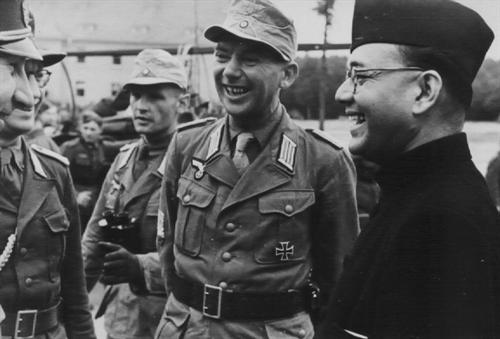
Netaji Subhas Chandra Bose – Truest KarmaYogi

Mantra of Uttishthata Jagrata Prapya Varan Nibodhata (Arise, Awake and Stop not till the Goal is Reached), uttered by Swami Vivekananda, cyclonic Hindu monk, led to a great impact on the Hindu society (during late 19 th century). Not this clarion call inspired Hindus, youth in particular, only but had a strong influence on the then national political scenario also. Young political leadership, completely drained and enraged due to moderate views of the Indian National Congress against British Government by then, was in search of an alternative to oust alien and villainous British Raj. The historic call made them realize the need to be radical and struggle.

Anushilan Samiti (Self-Culture Association), foremost secret revolutionary organization operating in Bengal, was set up in 1902 based on the ideals of Swami Vivekananda. Members of the association were dedicated (par excellence) to the way of armed revolution for independence of India from British rule and created terror in the British administration soon. Hindu ideal of perfect confluence of Bhakti and Shakti came up once again (after centuries) and showed the world truest essence of Hinduism. Birth of Subhas Chandra Bose, venerated more as Netaji, in 1897 took place amidst all these.

As a perfect son of this fiery era, Subhas, from his tender age had a great devotion to Dharma and was found to meditate for hours too. Devotion to Hindu Dharma in him was so high that once asceticism appeared to him as the best way. But after lots of failed efforts and disappointments he found solace in the literature of Swami Vivekananda; he considered Swami as his own Guru.

Subhas was considered as the ideal convergence of Bhakti and Shakti by his comrades even. It is quite amazing to note that even in his tiring times, be it the formation of Bengal Volunteers during the 1928 Kolkata session of Indian National Congress or his election as the president of Indian National Congress or his expulsion from the same party, he used to go through Srimad Bhagavad Gita and other Hindu religious books on a daily basis. Numerous citations can be quoted to prove the same.

It is also no secret fact any longer that Bose was influenced by VD Savarkar, renowned theoretician and leader of All India Hindu Mahasabha, to change the track of his actions. As per Savarkar, Bose was wasting time in agitating for removal of Holwell Monument in then Calcutta and so he was advised to wage the war of national liberation from outside of India. Surely this historical advice changed Bose’s life on the whole.

Exponents of alleged secularism in India can be silenced by the fact that Netaji had high regards for Savarkar and also recognized his role. In his speech on Azad Hind Radio (June 25, 1944) he admitted Savarkar's wisdom through these words: "When due to misguided political whims and lack of vision, almost all the leaders of Congress party have been decrying all the soldiers in Indian Army as mercenaries, it is heartening to know that Veer Savarkar is fearlessly exhorting the youths of India to enlist in armed forces. These enlisted youths themselves provide us with trained men and soldiers for our Indian National Army."

Testaments also prove even when Indian National Army (Azad Hind Fauj) was engaged in life and death struggle Netaji used to read Srimad Bhagavad Gita, Sri Sri Chandi and perform Puja daily.

Netaji Subhas Chandra Bose is indeed the most perfect KarmaYogi.


Saturday, April 23, 2011

Hindus have to claim Swastika

What is Swastika? If any person is asked this question ever, there will be only one answer beyond doubt. Swastika, also known as Hakenkreuz, as per English Dictionary, is an official emblem of the Nazi Party and the Third Reich; a cross with the arms bent at right angles in a clockwise direction. Is this enough? Well, to any person, preferring to remain content with half-true knowledge, this can be the best one. Nevertheless, to any sane individual, this is surely not enough. It is to be noted that any emblem doesn’t come on its own; there remains an anecdote or chronicle predating its final public appearance.

In the same way, Swastika also has a history and is certainly not a symbol propounded by the Nazis for the first time. Swastika has a rich history and a legacy, in full swing through centuries. To anyone’s amazement, Swastika has its foundation in the Hindu culture and comes from the Sanskrit word svastika, standing for any lucky or auspicious object, and especially a mark made on persons and things to designate good fortune. On the word of Alexander Cunningham, shape of Swastika stands for a monogram formed by interlacing of the letters of the auspicious words su-astí (svasti) written amply in Ashokan characters.

Without a doubt, Swastika has also been used exceedingly in both Buddhism and Jainism, two offshoots of Hindu Dharma, and in artifacts of royal dynasties in the Indian subcontinent. Now the question remains – what do all these indicate? Swastika has been a part and parcel of Hinduism from time immemorial and none has the right to usurp it, even if this is a reality, thanks to Nazis. Notably the Sanskrit term has been in application in English ever since 1871, replacing gammadion (from Greek γαμμάδιον). The substitute historical English spellings of the Sanskrit word happen to be suastika, swastica and svastica

What happened in the 1930s in Europe under the auspices of German Nazis, headed by Adolf Hitler, was nothing but an unblushing theft of Hindu contribution. However, in his 1925 work Mein Kampf, Adolf Hitler, wrote with conviction, “I myself, meanwhile, after innumerable attempts, had laid down a final form; a flag with a red background, a white disk, and a black swastika in the middle. After long trials I also found a definite proportion between the size of the flag and the size of the white disk, as well as the shape and thickness of the swastika.”

What made Nazis link to Swastika altogether? In accordance with scholars, even of different schools of thoughts (indeed a rare trait on their part to get united regarding a single issue), effective application of Swastika was assisted by Nazi theorists with their inference of Aryan cultural descent of the German people. Conforming to this Nordicist chronicle of Aryan invasion theory, German Nazis asserted that early Aryans of India, originators of ancient Vedic tradition and certainly Swastika, were the classical white invaders, rejected by an assortment of historians and pundits of India straight away. It must also be stated that the notion of racial purity, ideological belief to Nazism, played a key role to make Swastika an abhorrent Nazi emblem.

Truly, for all these, Swastika has been made despicable and also banned in several parts of the globe. But it has got to be said over and over again that Swastika has never been any emblem of Aryan master race but a sanctified one of Hindus.

Hindus have got to claim Swastika now and even if this hard stand infuriates anyone, there should not be any compromise. Swastika must be used in any Hindu religious, social affair devoid of any hesitation.


Tuesday, April 19, 2011

Taking on Islamic hard-line? Be prudent, innovative and vicious like it

Truly the saga of Islam is extending its tentacles throughout the globe and as per latest researches, at the present time, it enjoys 1.57 billion adherents, making up 23% of the world population. This is certainly a major feat and may be you are averse to all these but the reality can’t be expunged even for once. Well, personally I would have been happiest if all these had taken place peacefully. But again – the reality is something else. The progression of Islam has never been peaceful and where on earth it has reached, got associated with the land and made it as its bastion, a river of blood has been the first and foremost feature.

Mysticism is not uncommon in Islam but a good number of theologians confirm that any such tenet has failed to sustain its own independent presence like other religions on the whole and has been made use of over and over again to persuade Kafir s (non-believers in Islam) to become Muslim.

Now a question comes to pass to a student of management. Which techniques have played most important roles to sustain the victory march of Islam? Indeed there are lots; there have been innovations in development and execution of those through centuries and all these have led to the growth of Islamic extremism.

Don’t consider me as an infidel if I fail to differentiate between extremism and Islam, in full swing for more than a millennium. But if one is too interested to know the techniques, he must heed Allama Tahir Ashrafi, Chairman of Pakistan Ulema Counsel (PUC). The honorable individual has recently stated that easy availability of instigating literature in the market happens to be the core reason behind the exponential growth of extremism in Pakistan. He was found to state the same while denouncing a recent bomb blast in Lahore, leading to death of more than 10 persons and injury of hundreds of others.

In accordance with revered Allama Tahir Ashrafi, literature and CDs spreading hate against all schools of thoughts are highly available in Pakistani markets. And the governance in Pakistan simply fails to take any action against all these.

Is the situation in India too different? To find out the reality one must have a clear and unbiased perspective. A little introspection is enough to determine the reality. Almost each and every Muslim locality (termed as ghetto by Indian secularists) across India is getting stronger bit by bit. Undoubtedly, the aforesaid areas are arsenals but apart from these hate literatures and treasonable CDs are being found here at random.

Muslims to strengthen Islamic Ummah (the Muslim community or people, considered to extend from Mauritania to Pakistan) and conquer non-Islamic areas innovate newer techniques every now and then. If one has to live by taking on and trouncing Islamic proficiency, he must be smart, prudent and also roughshod at the same instant.


Wednesday, January 12, 2011

Hindu Samhati Salutes Swami Vivekananda, the Revolutionary Sannayasi on His Birth Anniversary

On 12th January 2010, Hindu Samhati Salutes the Great Hindu Reformer and Leader, Swami Vivekananda on His Birth Anniversary. Our organization is inspired and enthused by Swamiji's vision of Equality and Love for All. This is a small biography of this great figure of Indian History.

The origin of Hindu Dharma remains a mystery but in all these years tens of thousands of Sannayasi (sages) and philosophers have come to the fore and explained the Dharma in an assortment of forms. But among all these people Swami Vivekananda remains distinctive thanks to his vigor, knowledge and radical frame of mind. How was he introduced to all these? Born as Narendranath Dutta on January 12, 1863, the young Swami Vivekananda had a great interest in religious aspects and his thirst for spiritual knowledge and to know the reality led to his introduction to Sri Sri Ramakrishna Paramahamsa, one of the greatest religious mystics in the 19 th century India.

With the passage of time young Narendranath became his chief disciple and came to be known as Swami Vivekananda in later times. Swami Vivekananda had lots of successes. While on one hand he founded the Ramakrishna Mission (globally acclaimed spiritual and philanthropic institution), he is also termed as the central figure in introducing philosophies of Yoga and Vedanta across the globe, especially Europe and United States.

Swami Vivekananda deserves the credit of making Hinduism a world religion (that is being perceived these days). Swamiji is also considered as the Father of revival of Hinduism in the modern India and the notion of Hindu Rashtra. It was none other than him who introduced Hinduism at the Parliament of the World's Religions at Chicago in 1893 when he was traveling allover the globe as a wondering monk simply. His dynamic presence and vibrant speeches inspired the then young generation to a great extent who founded a large number of revolutionary organizations, especially in Bengal, to dethrone the British Imperialism.

Some of the noted organizations were Anushilan Samiti and Jugantar whose members through their fiery deeds created furor among the governance. The influence of Swami Vivekananda can also be found in the realm of literature as well. The globally revered poet Rabindranath Tagore, told Romain Rolland: "If you want to know India, read Vivekananda, in him everything is positive and nothing is negative."

Swami Vivekananda, attaining the mission of his life, went for the heavenly abode on July 4, 1902.

Sunday, December 26, 2010

Swami Sraddhananda : Hindu Samhati Salutes This Great Warrior-Saint of Hindu Samaj

Swami Sraddhananda spearheaded a successful Shuddhi movement to bring back converted Indian Muslims back to Hinduism. Converting back tens of thousands of Muslims (whose ancestors were forcibly converted to Islam from Hinduism) to their original Hindu faith, Swami-ji and the Arya Samaj movement is a major inspiration for Hindu Samhati.

It is a unfortunate that with the passage of time, we are losing the memory of the noble sons of India and one of them is surely Swami Sraddhananda. How many of us are familiar with the name of Swami Sraddhananda? He should have been one of the most revered personalities in the history of Indian freedom struggle and termed as one of the true liberators of the Hindu society as well. We draw vital inspirations from the life history of this venerated sage.


Swami Sraddhananda was the founder of "Gurukul Kangri", positioned in the religious city of Haridwar, and played one of the most vital roles in the national freedom struggle. His life was full of a lot of ups and downs but it was his intrinsic virtues that helped him to overwhelm all forms of adversities. Here is a brief analysis of his successes as a leader. Swami Sraddhananda is regarded as the pioneer in women’s education and it is said had there been no such person, the cause of womens' education would not have reached the present level. The same is said regarding his pioneering work in widow remarriage and class reformation.

Nevertheless, the aforesaid acts were only a miniscule in his biography. He had the dream of setting up a new form of Gurukul and this can be found from his arduous performance in implementing the same in several parts of pre-partition India. In due course, especially the arrest and deportation of Lala Lajpat Rai, his association with the national freedom struggle got deeper.


While on one hand he was transformed into a savior of Arya Samaj, on the other hand he was transformed into a leader of national importance. He had good relations with Mahatma Gandhi in the initial days, strong differences of opinions started to rise between the two in the end. Indian National Congress was involved in wooing and appeasing the Muslim community in the whole of India earning strong criticism of Swami-ji.

The Shuddhi step pioneered by Swami Dayananda Saraswati and adopted by Arya Samaj under guidance of Swami Sraddhananda saved millions of Hindus not even from being lost and also opened doors closed from centuries for entry of countless brothers and sisters who were lost with the cruel passage of time. On 13 Feb 1923 in Agra Swami-ji established Bhartiya Hindu Shuddhi Sabha of which he was elected president and Lala Hansraj as vice president.

An example of the Shuddhi work done by Swami-ji involved over 30,000 Malkana Rajputs and their restoration in the Hindu society and saving of thousands of Hindus from conversion, a strong and hidden agenda of Muslims in the subcontinent.

All these notable and revolutionary successes were too much for the fanatic Muslims to withstand and on 23 rd December 1926 he was assassinated by Abdul Rashid, a Muslim fanatic. The assassin entered his home at Naya Bazar, Delhi, in the form of a visitor and fired two bullets point-black into his chest in due course. Thus ended a great life.

25th Dec, 1926 witnessed a wave of emotions in the streets of Delhi as millions of people assembled to have the last glimpse of Swami ji who dedicated himself for the Vedic Hindu Dharma. Shraddhananda Park in Kolkata was named after the saint. Hindu Samhati, a major Hindu force in the eastern part of the Indian subcontinent, has held major meetings here. Numerous other memorials were also erected across India to commemorate the great saint and his deeds.

We offer a million salutes to this Great Warrior-Saint of our community, and do prarthana that we will be guided by leaders like him for our future work.